The Secret Summer Pattern You Need to Know
Editor’s Note
Over the past couple of days, water temperatures around the Tomahawk area have dropped approximately 7 degrees following the recent stretch of cooler weather. While that is encouraging, warmer temperatures are expected again this weekend, so conditions may change quickly. Keep the recent temperature swing in mind as you plan your time on the water.
LVO Sportfishing Weekly Report
By Tim Buffington
Hey there, Northwoods anglers, and welcome back to the LVO Sportfishing Report! I’m Tim Buffington, ready to get you dialed in for another week of fantastic fishing here in the Northwoods. Mother Nature gave us a quick break from the heat last week, but things are amping right back up—and so are those water temperatures!
Finding Fish in the Heat
Speaking of rising water temperatures, I stumbled onto a really cool pattern last week while scouting for an upcoming trip. I was checking all the normal summertime community spots on a local reservoir, and every single one came up totally blank.
Instead of grinding it out where the fish should be, I pointed the boat toward the main lake basin, turned on AutoChart Live, and started scanning with side imaging.
Sure enough, I stumbled onto a tiny micro-hole—not a hump, but a small depression roughly the size of a football field that dropped just two feet deeper than the surrounding basin.
That subtle depth change was absolutely stacked with life. It looked like every fish in that part of the reservoir was squeezed into that cooler pocket to beat the heat.
You would think that many fish jammed into one spot would create an instant beatdown, but we definitely had to work for every bite. In a spot like that, early mornings and late evenings are likely prime time.
With water temperatures constantly shifting, those fish probably do not stick around long. A change of only a couple of degrees can send them back out roaming the open basin and feeding on bugs and minnows.
It was a great reminder of how paying attention to your electronics and side imaging can save a difficult day on the water.
Guide Tip
Do not overlook small depth changes in otherwise featureless water. A depression only two feet deeper than the surrounding basin may hold a surprising concentration of fish during hot weather.
Deep-Water Smallmouth and Walleye Action
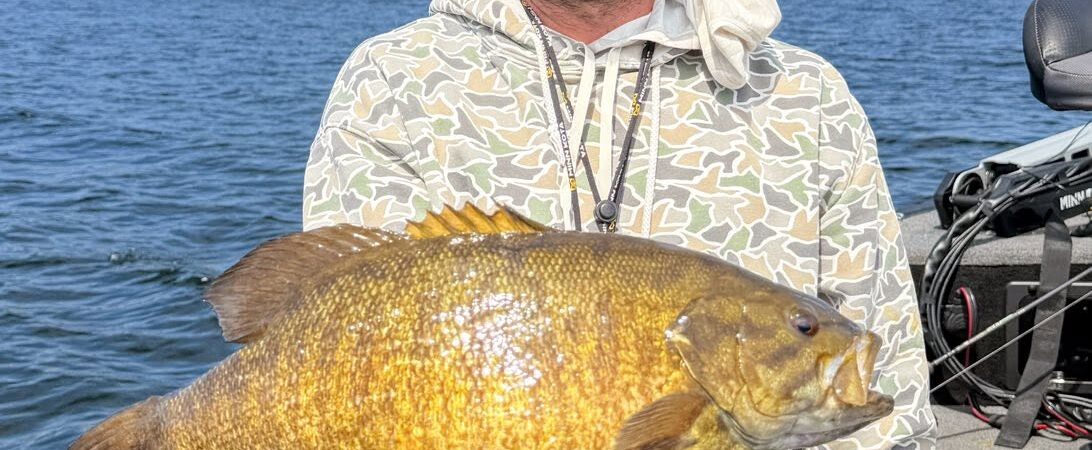
Now, let’s talk bass—specifically those brown bass. I had a trip last week with a repeat client who absolutely loves targeting them.
Bob’s go-to tactic is throwing shallow Cotton Cordell crankbaits. It is an awesome, action-packed pattern, but given the extreme summer temperatures, I had a feeling our best opportunity would be those deeper rock bars and weed edges I discussed a couple of weeks ago.
Bob also brought his brother Dave along and wanted to get him on some walleyes, so heading deep fit the plan perfectly.
We had some good wind pushing across the water that morning. Instead of drifting, we used Spot-Lock just upwind of a deep rock bar extending well into the main basin and cast back down across it.
Not even ten minutes later, Bob’s rod doubled over. He landed a beautiful 20-inch smallmouth that inhaled a jig tipped with a nightcrawler.
We stayed with that pattern for the rest of the day and caught a solid mix of smallmouth bass and walleyes.
Selective Smallmouth Harvest
The guys even kept a few eater-sized smallmouth to take home for dinner, which is something that gets overlooked far too often as great table fare.
On certain bodies of water, strict catch-and-release is necessary to protect special, slow-growing fisheries. However, on lakes overloaded with smallmouth bass, selective harvest can actually be good conservation.
When a lake becomes overcrowded, the population can stunt, leaving hundreds of bass that rarely grow beyond 15 inches. Taking home a few legal, mid-sized fish helps balance the fishery, reduces competition, and gives the remaining fish more food and room to grow into true giants.
This Week’s Outlook
Musky
Looking ahead to this week, with the continued heat, I would still strongly consider laying off muskies until water temperatures fall back into the 70s.
Muskies might be the toughest fish in the lake, but they are also highly susceptible to delayed mortality when the water gets too warm.
If you do plan to target them, consider skipping the measuring tape altogether. Take one very quick photo and get the fish back into the water immediately. An extremely fast release is always the best practice.
Warm-Water Musky Reminder
Monitor surface temperatures carefully. If the water climbs back into the upper 70s, consider targeting another species until conditions improve.
Walleye and Bass
For walleyes and bass, I expect the bite to remain solid in those same deeper areas. Continue searching for subtle basin depressions, deep rock locations, rock bars, and deep weed edges.
Casting nightcrawlers or suspending them beneath slip bobbers should continue to produce. Anglers who prefer finesse plastics should also do well with Ned rigs and drop-shot rigs.
This Week at a Glance
Best locations: Deep rock bars, weed edges, micro-holes and subtle basin depressions
Best presentations: Jigs and nightcrawlers, slip bobbers, Ned rigs and drop shots
Best bite window: Early morning and late evening
Strongest species: Smallmouth bass and walleye
Musky outlook: Use caution and avoid targeting them when water temperatures become excessive
From LVO Sportfishing
That is your LVO Sportfishing Report for this week. Get out there, stay safe, and enjoy another fantastic week of fishing in beautiful Northern Wisconsin!
Before heading out, be sure to stop at Aquatic Arts Fishing Pro Shop for fresh live bait, tackle, rods, reels, and the latest local fishing information.
As a proud member of the St. Croix Pro Staff, I highly recommend keeping the Best Rods on Earth in your hands this season.
Ready to swap screen time for sunshine and smiles on the lake? Give LVO Sportfishing a call at 715-612-1090, or find LVO Sportfishing on Facebook for the latest updates.
As always, good conservation means great fishing ahead, so do not be afraid to let them go so they can grow.
Tight lines, everyone, and have a great week!